Subterranean termite treatment in Houston requires an engineered defensive barrier calibrated to the heavy montmorillonite clay soils across Harris County. Native eastern subterranean colonies and voracious Formosan…
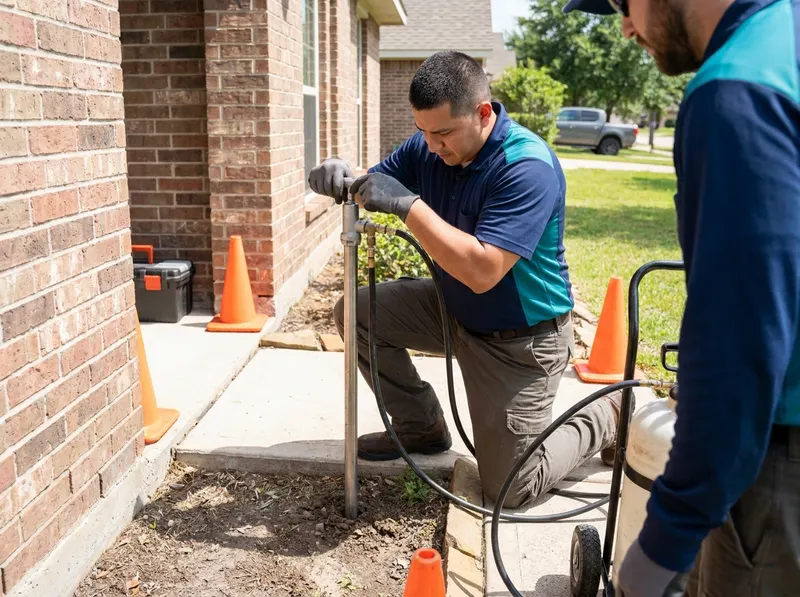
Subterranean termite treatment in Houston requires an engineered defensive barrier calibrated to the heavy montmorillonite clay soils across Harris County. Native eastern subterranean colonies and voracious Formosan colonies migrate upward from moist soils beneath slab foundations, pier-and-beam joists, and weep screeds. Routine retail sprays fail because repellent chemicals simply scatter foragers to unshielded entry gaps without neutralizing the central reproductive queen. Professional management relies on non-repellent active ingredients registered through the U.S. Environmental Protection Agency, such as fipronil or imidacloprid, which foragers track directly through colony tunnels via grooming behavior. According to structural pest management standards maintained by the Texas Department of Agriculture Structural Pest Control Service, treatments must establish continuous chemical or bait coverage around the exterior foundation footprint without breaking protective lines.
Treatment selection balances liquid soil barriers against monitored baiting arrays. Liquid termiticide trenching is applied at four gallons per ten linear feet into continuous six-inch trenches dug against exterior brick ledges and slab foundations, reaching subterranean root systems. This method protects ground-level slabs commonly found in The Heights, Oak Forest, and Meyerland. For properties in Montrose, River Oaks, and Memorial featuring dense mature tree root systems, extensive decorative hardscaping, or close proximity to high water tables, bait stations installed at ten-foot intervals provide targeted population suppression. The Pest Control Technology technical guides document that hexaflumuron and noviflumuron bait matrices disrupt termite molting cycles over three to six months without disturbing fragile landscape roots. Research published through the Texas A&M Department of Entomology demonstrates that subterranean worker termites ingest non-repellent compounds and spread the lethal dosage across secondary reproductives and foraging castes.
Foundation construction dictates specific structural treatment modifications. Historic pier-and-beam residences in West University Place require internal crawlspace trenching around every interior support block, supplemented by targeted masonry void injections. High-density commercial and residential complexes near Kingwood and Clear Lake face increased pressure from Formosan termites, which can establish secondary aerial carton nests inside wall cavities without ground contact if interior plumbing leaks or humid air ducts provide moisture. Guidelines published by the Florida Department of Agriculture and Consumer Services, a key authority on Formosan tracking, confirm that moisture management must pair with liquid termiticide barriers to prevent recurrent carton development. Structural engineers at the American Society of Civil Engineers emphasize that soil shifting during intense Texas droughts can open hairline foundation cracks as small as 1/32 of an inch, granting subterranean foragers immediate pathway access to structural framing.
Environmental protection standards ensure indoor air and groundwater safety during application. Defensive barrier formulations adhere strictly to chemical drift and runoff parameters verified by the Texas Commission on Environmental Quality to safeguard bayou watersheds, including Memorial Park and Buffalo Bayou drainage zones. ZephyrShield Exterminators configures non-volatile liquid defenses that bind tightly to organic soil particles, eliminating vapor off-gassing into interior living rooms, bedrooms, or pet quarters. Safe management protocols defined by the National Institute for Occupational Safety and Health and pesticide applicator standards monitored by the Association of Structural Pest Control Regulatory Officials govern our high-pressure sub-slab injection tools. For immediate evaluation of active mud tubes, swarmers, or degraded framing timber, call (107) 407-7064 to schedule an on-site perimeter barrier inspection.
Every job gets a firm, written price after a free on-site visit.
For standards, safe disposal, and service guidance on pest control services in Houston, TX, useful references include U.S. EPA, ENERGY STAR, U.S. Dept. of Energy, Consumer.gov, U.S. Census Bureau, and Google Maps. General consumer and small-business resources are available from USA.gov, Better Business Bureau, FTC Consumer Advice, U.S. Small Business Administration, and Ready.gov.
Tell us about your subterranean termite treatment job in Houston and we'll send a clear, written quote, usually the same day.
 ZephyrShield Exterminators