Commercial food handling operations along the Gulf Coast encounter severe biological load due to persistent humidity, where ambient conditions in Houston routinely surpass 75% relative humidity, dramatically…
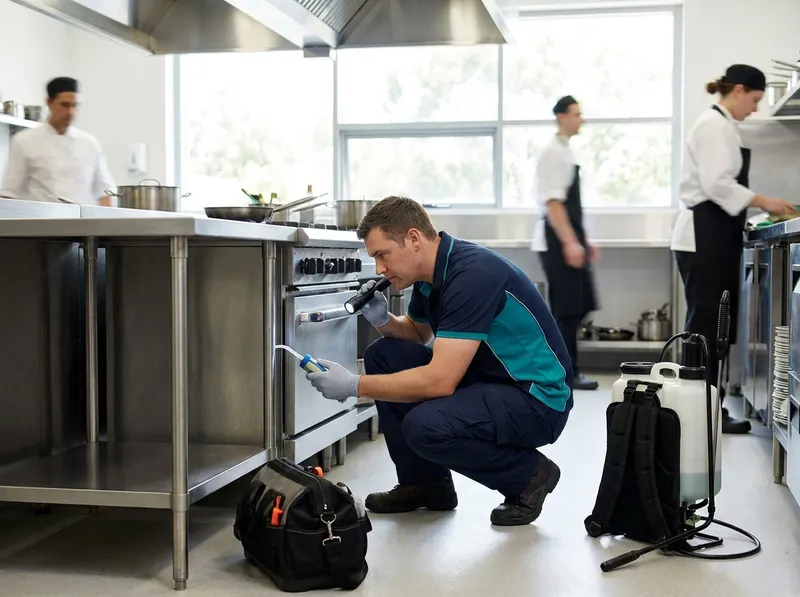
Commercial food handling operations along the Gulf Coast encounter severe biological load due to persistent humidity, where ambient conditions in Houston routinely surpass 75% relative humidity, dramatically accelerating the life cycle of Texas A&M AgriLife Extension-monitored populations of German cockroaches from egg to reproductive adult in under 40 days. In dense food distribution hubs and commercial kitchens across The Heights, Montrose, and River Oaks, pest control services require clinical containment rather than broad-spectrum airborne sprays. Commercial kitchen and facility pest management in Houston integrates strict alignment with the FDA Food Safety Modernization Act standards. This protocol isolates moisture channels beneath three-compartment sinks, walk-in coolers, and floor drains using bio-enzymatic foam treatments that digest residual grease cakes where fly larvae feed. Establishing a reliable barrier prevents grease-loving insect vectors from reaching ambient packaging zones without exposing food-prep lines to harsh chemical volatilization.
In larger logistical footprints such as institutional processing plants in Memorial, cold storage warehouses in Clear Lake, and food service cafeterias in West University Place, facilities face distinct rodent intrusion points along dock levelers and utility conduits. Structural integrity guidelines established by the U.S. Department of Housing and Urban Development and commercial architectural benchmarks from the National Institute of Building Sciences demonstrate that a standard quarter-inch gap under an exterior roll-up door allows juvenile rodents instant access to palletized raw ingredients. The operational barrier approach utilizes brushed industrial sweeps, stainless steel mesh fills, and non-toxic monitoring stations positioned strictly along primary interior perimeter pathways, directly satisfying CDC National Center for Environmental Health food safety inspection metrics. The physical perimeter seals out invaders while protecting indoor air chemistry around open cooktops and mixing vats.
Selecting the correct defense model hinges on structural layout versus operating schedule. A quick-service restaurant in Oak Forest with a 1,500-square-foot footprint benefits most from concentrated interior drain biosanitation combined with passive pheromone traps, requiring minimal off-hours entry. Conversely, a 25,000-square-foot processing plant in Kingwood or Meyerland requires multi-tier perimeter management under OSHA General Industry Standards, integrating dock defense, ceiling plenum tracking for roof rats, and zero-pesticide thermal treatment along mechanical baseboards. While basic spot sprays offer only temporary knockdown and risk aerosol drift over stainless steel tables, engineered perimeter management enforces physical exclusion and low-toxicity micro-encapsulated baits tested under EPA pesticide program guidelines. This non-volatile barrier method controls the vector population at the foundation, eliminating the biological cycle while maintaining uninterrupted health code adherence under the Texas Department of State Health Services Retail Food Establishments guidelines.
Operational implementation proceeds through 4 sequential phases: 1. A physical perimeter and moisture analysis checks pipe penetrations, grease interceptor vents, and floor joints against National Pest Management Association commercial guidelines. 2. Ultrasonic and mechanical bio-enzymatic dosing flushes commercial drainage lines to eliminate biological food reservoirs. 3. Physical exclusion installs high-gauge elastomeric seals and stainless mesh across exterior door thresholds and expansion gaps under ASTM International structural specifications. 4. Tamper-resistant, barcoded tracking monitors are established along sub-floor runs to provide automated regulatory documentation.
Every job gets a firm, written price after a free on-site visit.
For standards, safe disposal, and service guidance on pest control services in Houston, TX, useful references include U.S. EPA, ENERGY STAR, U.S. Dept. of Energy, Consumer.gov, U.S. Census Bureau, and Google Maps. General consumer and small-business resources are available from USA.gov, Better Business Bureau, FTC Consumer Advice, U.S. Small Business Administration, and Ready.gov.
Tell us about your commercial kitchen and facility pest management job in Houston and we'll send a clear, written quote, usually the same day.
 ZephyrShield Exterminators