Targeted remediation becomes essential when over-the-counter pyrethroid formulations fail due to widespread insect physiological resistance documented across urban centers. Thermal remediation elevates room…
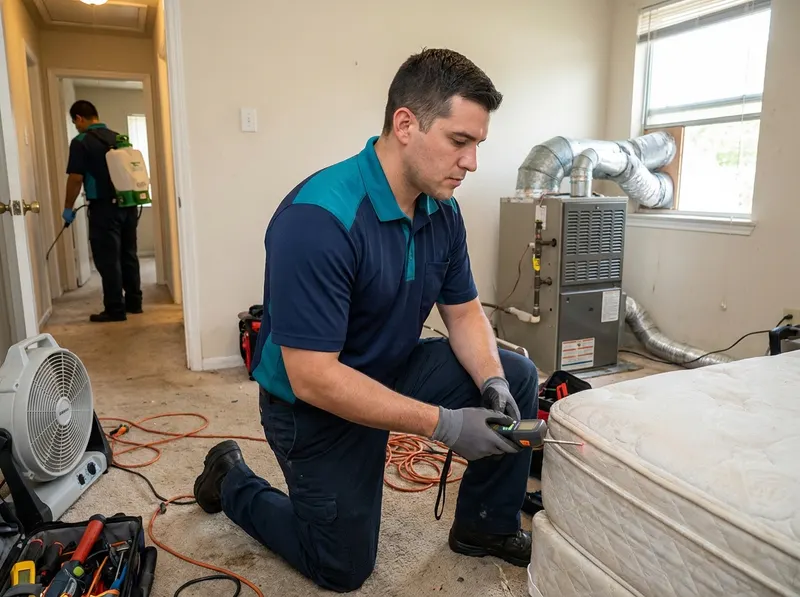
Targeted remediation becomes essential when over-the-counter pyrethroid formulations fail due to widespread insect physiological resistance documented across urban centers. Thermal remediation elevates room temperatures between 120°F and 135°F using industrial forced-air exchangers monitored by infrared thermography. This environmental heating process forces ambient heat through structural trim, baseboards, and deep upholstery fabrics, neutralizing adult bed bugs and desiccating egg clutches without introducing airborne particulate hazards. According to structural guidelines from the U.S. Environmental Protection Agency, achieving sustained core structural temperatures above 118°F for 90 minutes achieves total mortality across all life stages, preventing the reproductive rebound common with standalone retail misting systems.
While thermal treatment penetrates inaccessible structural voids, environmental trade-offs require pairing heat with localized chemical applications. Heat alone provides no ongoing protective perimeter once cooling completes; consequently, combining convective heat with precise application of non-repellent liquid formulations and desiccant dusts ensures incoming or surviving perimeter vectors cannot re-establish harborages. ZephyrShield Exterminators applies targeted barrier defenses under the structural standards outlined by the Pest Control Technology guidelines and rules overseen by the Texas Department of Agriculture structural pest division. This hybrid methodology resolves heavy infestations across diverse architectural styles, from older pierced-slab bungalows in The Heights and Montrose to expansive subfloor assemblies in Memorial and River Oaks.
Houston's persistent Gulf Coast humidity and extended thermal seasons create unique behavioral vectors for indoor parasites. Relative humidity exceeding 70% protects pest cuticles against mechanical desiccation, allowing populations inside wall voids near Hermann Park or Buffalo Bayou to reproduce at elevated velocity. Technical execution adheres to workplace exposure parameters set by the Occupational Safety and Health Administration while referencing developmental studies cataloged by the Entomological Society of America. Structural treatments account for specific building envelopes, whether mitigating shared-wall transfers inside dense apartment complexes in West University Place or detaching heavy insect clusters inside detached residences throughout Meyerland, Oak Forest, Clear Lake, and Kingwood.
Implementation follows an objective, sequential protocol to guarantee systematic structural containment: 1. Technicians survey internal architecture using digital thermal monitors and acoustic detectors to locate active harborages. 2. Fragile electronics, pressurized canisters, and heat-sensitive possessions are cataloged and protected per protocol. 3. Convective heating systems engage, sustaining temperatures between 122°F and 135°F for a measured window of 4 to 6 hours while circulating air into subfloor chases. 4. Following structural cool-down, technicians apply microencapsulated residuals and silica-based desiccant formulations to wall cavities, plumbing penetrations, and perimeter carpet tacking strips in compliance with Consumer Product Safety Commission consumer protection guidance. 5. Follow-up digital inspections verify complete clearance, backed by educational recommendations aligned with Centers for Disease Control and Prevention guidance, Department of Housing and Urban Development standards, and structural reference documentation maintained by National Institute of Standards and Technology materials testing.
Every job gets a firm, written price after a free on-site visit.
For standards, safe disposal, and service guidance on pest control services in Houston, TX, useful references include U.S. EPA, ENERGY STAR, U.S. Dept. of Energy, Consumer.gov, U.S. Census Bureau, and Google Maps. General consumer and small-business resources are available from USA.gov, Better Business Bureau, FTC Consumer Advice, U.S. Small Business Administration, and Ready.gov.
Tell us about your bed bug thermal and chemical remediation job in Houston and we'll send a clear, written quote, usually the same day.
 ZephyrShield Exterminators