Gulf Coast humidity and long heat seasons cause attics along Buffalo Bayou and White Oak Bayou to experience attic temperatures reaching 140°F. When roof rats or squirrels access attic cavities in historic…
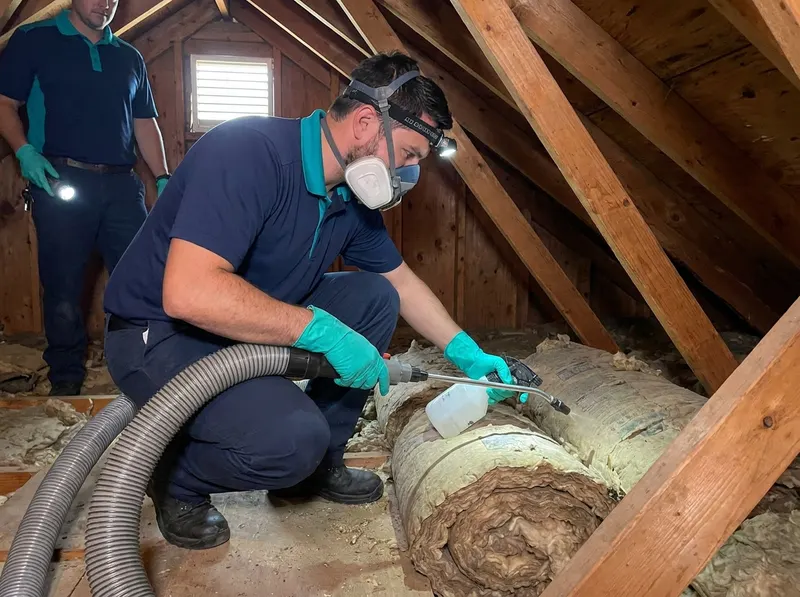
Gulf Coast humidity and long heat seasons cause attics along Buffalo Bayou and White Oak Bayou to experience attic temperatures reaching 140°F. When roof rats or squirrels access attic cavities in historic pier-and-beam properties throughout The Heights and Montrose, or newer multi-story foundations in West University Place and River Oaks, they compress loose material and leave pathogen-bearing waste. Attic restoration requires an engineered containment system. Technicians place negative-air machines fitted with HEPA filters verified under EPA indoor air quality protocols to capture airborne particulate matter. Blown cellulose or fiberglass batts are drawn through continuous 4-inch collection hoses into exterior disposal units, bypassing living spaces entirely to prevent cross-contamination.
Once substrates are clear, mechanical surfaces receive micro-misting biocides that break down organic waste, following standards outlined by the CDC rodent cleanup guidelines to neutralize urine deposits without generating caustic indoor fumes. Structural framing is then inspected according to OSHA residential construction safety regulations for load-bearing wood rot caused by trapped condensation. Air-sealing teams apply polyurethane foam around recessed light housings, electrical penetrations, and plumbing chases, cutting off air pathways where cool indoor air collides with attic heat. For properties in Oak Forest and Meyerland recovering from localized storm moisture, sanitization eliminates mildew spores before clean material enters the space.
The final phase replaces thermal boundaries to meet the prescriptive levels of the U.S. Department of Energy insulation guidelines, which call for up to R-38 protection across Climate Zone 2A in Harris County. Blown-in fiberglass or borate-treated cellulose creates an inhospitable barrier to insect nesting while stabilizing air-conditioning runtimes. In forested areas like Kingwood and coastal parcels around Clear Lake, sealing attic spaces against high ambient vapor pressure prevents summer thermal transfer from overloading HVAC systems. Structural waste disposal is conducted in compliance with Texas Commission on Environmental Quality municipal solid waste rules and local transfer station guidelines at City of Houston Solid Waste Management.
Technicians verify perimeter seals against common roof interfaces using Structural Engineers Association technical standards for building envelopes and coordinate barrier checks with National Pest Management Association structural guidelines to guarantee that roof rats, bats, and raccoons cannot re-enter soffit returns or ridge vents. Fire clearances around furnace flues and chimney stacks are maintained per the National Fuel Gas Code NFPA 54 and ventilation calculations are balanced according to ASHRAE building ventilation standards. Pricing remains transparent: spot remediations begin at our firm $200 minimum, and full restorations depend on floor square footage and damage severity, with exact totals confirmed during the free preliminary inspection.
Every job gets a firm, written price after a free on-site visit.
For standards, safe disposal, and service guidance on pest control services in Houston, TX, useful references include U.S. EPA, ENERGY STAR, U.S. Dept. of Energy, Consumer.gov, U.S. Census Bureau, and Google Maps. General consumer and small-business resources are available from USA.gov, Better Business Bureau, FTC Consumer Advice, U.S. Small Business Administration, and Ready.gov.
Tell us about your attic insulation cleanup and sanitization job in Houston and we'll send a clear, written quote, usually the same day.
 ZephyrShield Exterminators