Flea and tick yard and home treatments in Houston address the specific environmental pressures caused by sustained Gulf Coast relative humidity exceeding 75% and extended warm seasons that accelerate the reproduction…
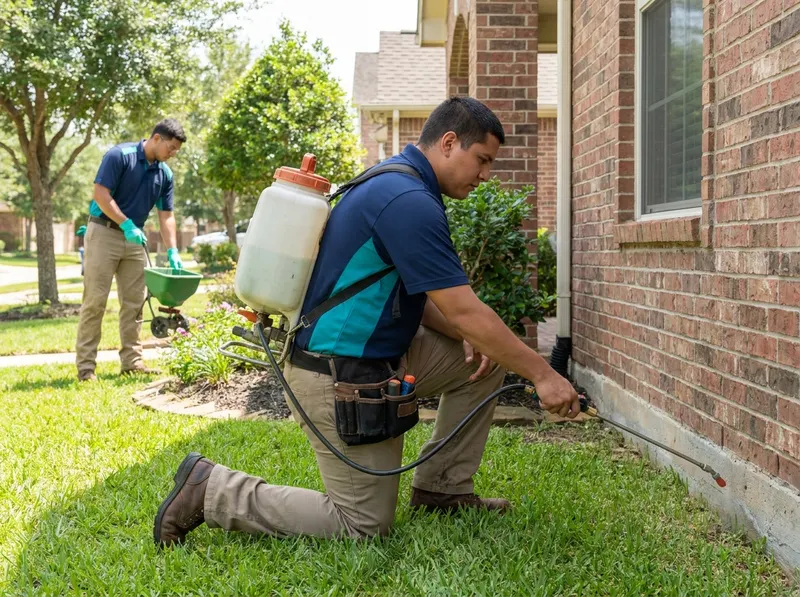
Flea and tick yard and home treatments in Houston address the specific environmental pressures caused by sustained Gulf Coast relative humidity exceeding 75% and extended warm seasons that accelerate the reproduction of the cat flea (Ctenocephalides felis). In dense turfgrass such as St. Augustine and Bermuda, larvae seek shelter at the soil line beneath the thatch layer, while female fleas deposit up to 50 eggs per day onto host animals that scatter across living room rugs and pet bedding. Outdoor management requires precise botanical-derived microencapsulated adulticides paired with an insect growth regulator, such as pyriproxyfen regulated by the Environmental Protection Agency, to arrest development before juvenile pupae transition into biting adults. The outdoor protocol extends through perimeter landscape beds, shaded fence lines, and low-hanging tree canopies mapped along bayou systems in Harris County.
Indoor eradication diverges fundamentally from yard suppression because over 90% of a flea population exists as eggs, larvae, and pupae within carpet pile, hardwood baseboard seams, and fabric fibers rather than on the pets themselves. Over-the-counter aerosol foggers disperse indiscriminately into upper room air without penetrating deep floor fibers where pupae reside inside protective silk cocoons that resist standard surface chemicals. Structural mitigation targets vacuumed floor registers, perimeter wall voids, and upholstered furniture using targeted aqueous applications containing synthetic pyrethroids evaluated by the National Pesticide Information Center. Technicians align treatments with the botanical guidelines established by the Texas A&M AgriLife Extension, ensuring indoor application zones dry completely within 120 to 180 minutes to establish an odorless protective barrier that remains inert to infants and domestic animals.
Subtropical microclimates across Houston alter pest distribution based on elevation, mature tree canopies, and localized drainage patterns. In mature, shaded parcels across Memorial, River Oaks, and The Heights, heavy live oak leaf mulch and proximity to Buffalo Bayou provide sustained moisture reserves favored by the lone star tick (Amblyomma americanum) and blacklegged tick (Ixodes scapularis), requiring granular systemic applications to penetrate decomposing organic matter. Conversely, properties in Clear Lake and Kingwood often face localized moisture retention near lakefronts that harbors the brown dog tick (Rhipicephalus sanguineus), an adaptable species capable of infesting baseboards, kennel runs, and wall voids indoors. Neighborhoods like Montrose, West University Place, Oak Forest, and Meyerland experience high residential density where wandering urban wildlife, such as opossums and raccoons tracked by the Texas Parks and Wildlife Department, continuously reintroduce viable parasite eggs into unfenced gardens and crawl spaces under pier-and-beam foundations.
Systematic eradication follows a structured four-stage mechanical and chemical sequence. First, homeowners wash all pet bedding in water heated above 130 degrees Fahrenheit, conforming to sanitation parameters set by the American Veterinary Medical Association, and complete a mechanical vacuuming cycle across 100% of exposed carpeted floors. Second, technicians execute an interior ground-level precision spray alongside structural edges, pet resting pads, and furniture bases using non-staining liquid compounds formulated under the structural supervision standards of the Texas Department of Agriculture. Third, exterior power-spraying rigs apply an active residual barrier out to property boundaries, blanketing turf down to the root crown and penetrating mulch beds up to a 3-foot height on exterior foundation brick. Fourth, technicians disperse moisture-activated macro-granules across open yard perimeters to withstand the heavy convective rainfall common to Southeast Texas, terminating re-infestation cycles without requiring binding long-term service contracts. Homeowners can reach ZephyrShield Exterminators directly at (107) 407-7064 to review site parameters.
Every job gets a firm, written price after a free on-site visit.
For standards, safe disposal, and service guidance on pest control services in Houston, TX, useful references include U.S. EPA, ENERGY STAR, U.S. Dept. of Energy, Consumer.gov, U.S. Census Bureau, and Google Maps. General consumer and small-business resources are available from USA.gov, Better Business Bureau, FTC Consumer Advice, U.S. Small Business Administration, and Ready.gov.
Tell us about your flea and tick yard and home treatments job in Houston and we'll send a clear, written quote, usually the same day.
 ZephyrShield Exterminators